
Authors: Harshit Gautam, Kamlesh Melana, Karl Redlich, Vitaly Kovalyov, Alex Barshai
Silver is a high-value metal, and every kilogram has a cost while it moves through a refinery. Most refinery managers can say what they sell each day. Fewer can say, to the nearest hundred kilograms, how much silver is sitting inside the plant at any moment: in the bath, in the anodes, in the bled electrolyte waiting to return. That number decides how much metal you finance and how exposed you are to the silver price.
For a long time, Moebius electrorefining was the only flowsheet most refiners had, so the silver it held was accepted as a cost of doing business. The process earned that trust: for anodes above 90% silver, a Moebius circuit is stable and robust, and lower grades went to double refining to reach 99.95%. Large swings in silver and gold prices have since pushed up lease and insurance costs, and the silver inventory is now a line refiners want to question.
This article adds up the silver in a Moebius refinery one bucket at a time, with the arithmetic shown so you can check it against your own plant, then shows how an emew digestion and electrowinning circuit changes the answer.
The short answer
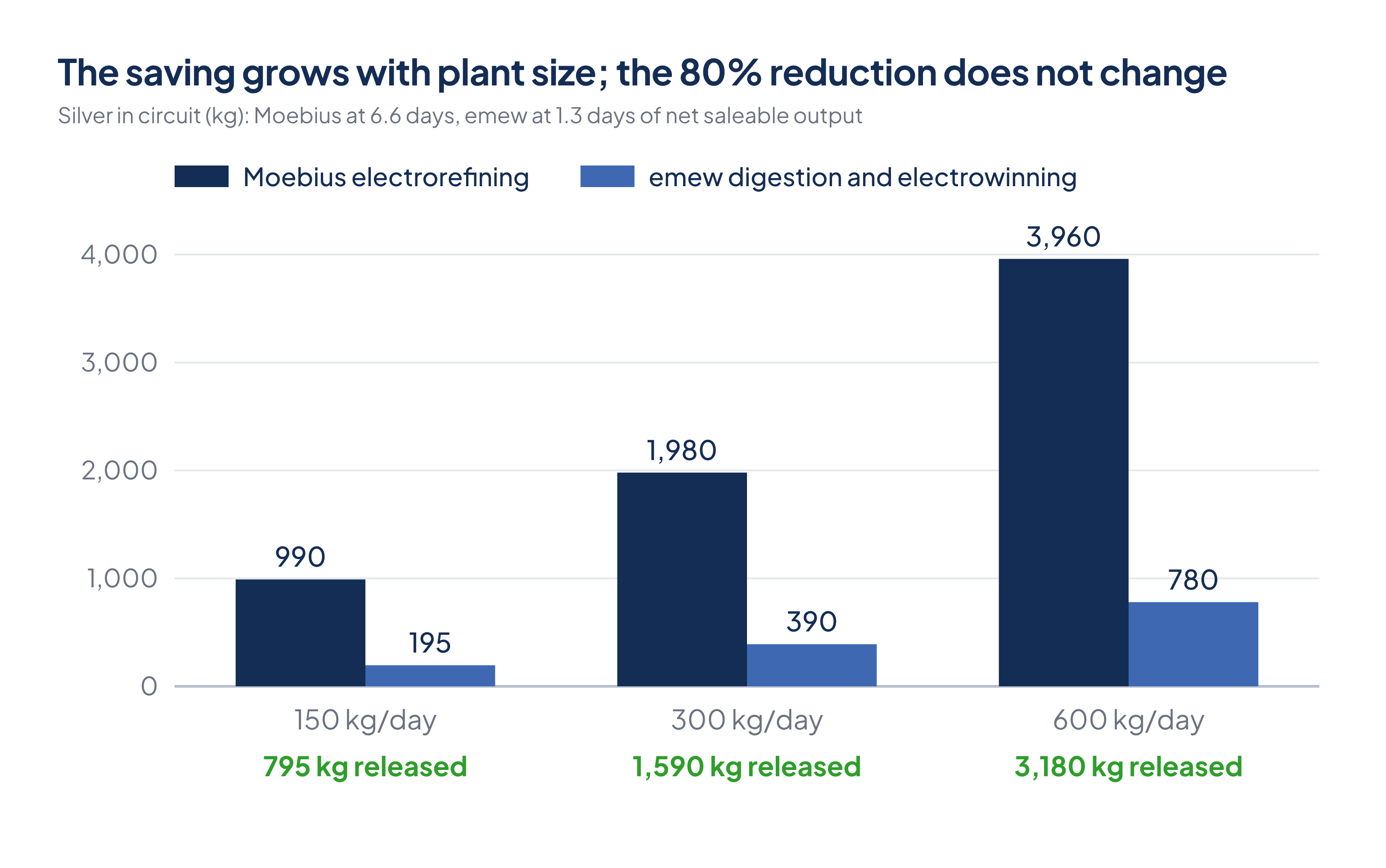
A Moebius silver refinery fed with 90% Ag anodes holds about 6.6 kg of silver in process for every kilogram it sells each day. An emew digestion and vortex electrowinning circuit holds about 1.3 kg in our base case. At 600 kg/day of net saleable output, that is 3,960 kg in Moebius against 780 kg in emew: 3,180 kg less silver in the emew circuit, an 80% reduction, or more than five days of production the refinery no longer has to finance.
At the end of September 2026, at a spot price of US$60/oz (US$1,929/kg, Kitco), the released silver is worth about US$6.13 million. At an 8% lease or financing rate, holding it costs about US$491,000 a year. Almost half (45%) of the Moebius silver inventory is in impure anodes deployed in the cells for refining, considering a four-day anode changeover cycle.
The gap widens as feed copper rises. At 25% copper, a Moebius circuit must replace its electrolyte every 3.6 days, against 10.8 days at 10% copper. Each change sends the dissolved silver through a chemical recovery loop and takes fresh silver for make-up of the bath.
What is silver work-in-progress (WIP), and why does it cost so much?
Silver WIP is every kilogram a refinery owns or holds on consignment between receipt and saleable bar. None of it earns anything until it leaves as product, yet someone owns it, leases it or finances it the whole time it is inside the plant.
Three terms used throughout
- Net saleable output is the silver sold each day. In the reference plant, the cells make 720 kg/day, 120 kg/day returns to the circuit as silver nitrate make-up, and 600 kg/day leaves as product. Every figure in this article is measured against the 600 kg/day product output.
- Silver in circuit is every kilogram between receipt and the saleable bar: in the electrolyte, in the anodes, in the bled electrolyte and in the make-up pool.
- Inventory multiple is silver in circuit divided by net saleable output per day. A multiple of 6.6 means 6.6 days of production are sitting inside the plant. It puts a 150 kg/day refinery and a 600 kg/day refinery on the same footing.
For most of the last decade, refiners could live with the cost. Silver traded at US$15 to US$25/oz, and silver lease rates typically ran at 1% to 2% a year (Phoenix Refining); in well-supplied years, one-month rates sat around 0.3% to 0.5% (TradingKey). Three things changed in 2025 and 2026.
- Silver reached a record of about US$121.6/oz on 29 January 2026 and was near US$60/oz at the end of September 2026 (Kitco), so the same kilogram in the tank is worth about twice its 2024 average of roughly US$28/oz.
- Silver lease rates hit a record 34.9% on 9 October 2025 (Bloomberg) and went above 100% at the height of the squeeze, when refiners stopped accepting feed that needed long processing (Phoenix Refining).
- Refiners of low-purity silver, who depend on nitric acid for chemical refining, also faced acid shortages (Phoenix Refining).
Why does a Moebius refinery need so much silver in circuit?
In a Moebius cell, the design sets the silver inventory, not how well the plant is run. The cells hang anodes of about 90% silver and 10% copper in a silver nitrate electrolyte. Current dissolves the anode, and pure silver crystals grow on the cathode. Copper dissolves with the silver and stays in solution, so it builds up. Once it reaches about 60 g/L, it starts to co-deposit and contaminate the crystal, so part of the electrolyte is bled off and replaced with fresh silver nitrate. Three design rules then fix how much silver has to be in the plant.
- Crystal purity needs a high silver concentration in the bath. Refiners run about 100 g/L Ag; lower concentrations give poorer crystals.
- The bath must be large enough to carry the current. Cell volume is set by how much silver the plant has to dissolve and plate each day.
- The anodes must have enough mass to last a full cycle. A four-day cycle means four days of dissolving must hang in the cells before they are changed.
The math at 600 kg/day, one bucket at a time
Our reference refinery sells 600 kg/day of silver. Its 24 Moebius cells, of 600 L each, make 720 kg/day from 90% Ag anodes on a four-day cycle, with ten 15 kg anodes per cell and a 100 g/L electrolyte. The cell parameters follow the published Moebius design basis (Habashi, Handbook of Extractive Metallurgy), scaled to 600 kg/day of net saleable output, as 120 kg/day is required for preparation of make-up volume. Silver sits in four places.
The electrolyte is volume times concentration. 24 cells of 600 L hold 14,400 L, or 24 L for every kg/day sold.
14,400 L × 100 g/L = 1,440 kg Ag
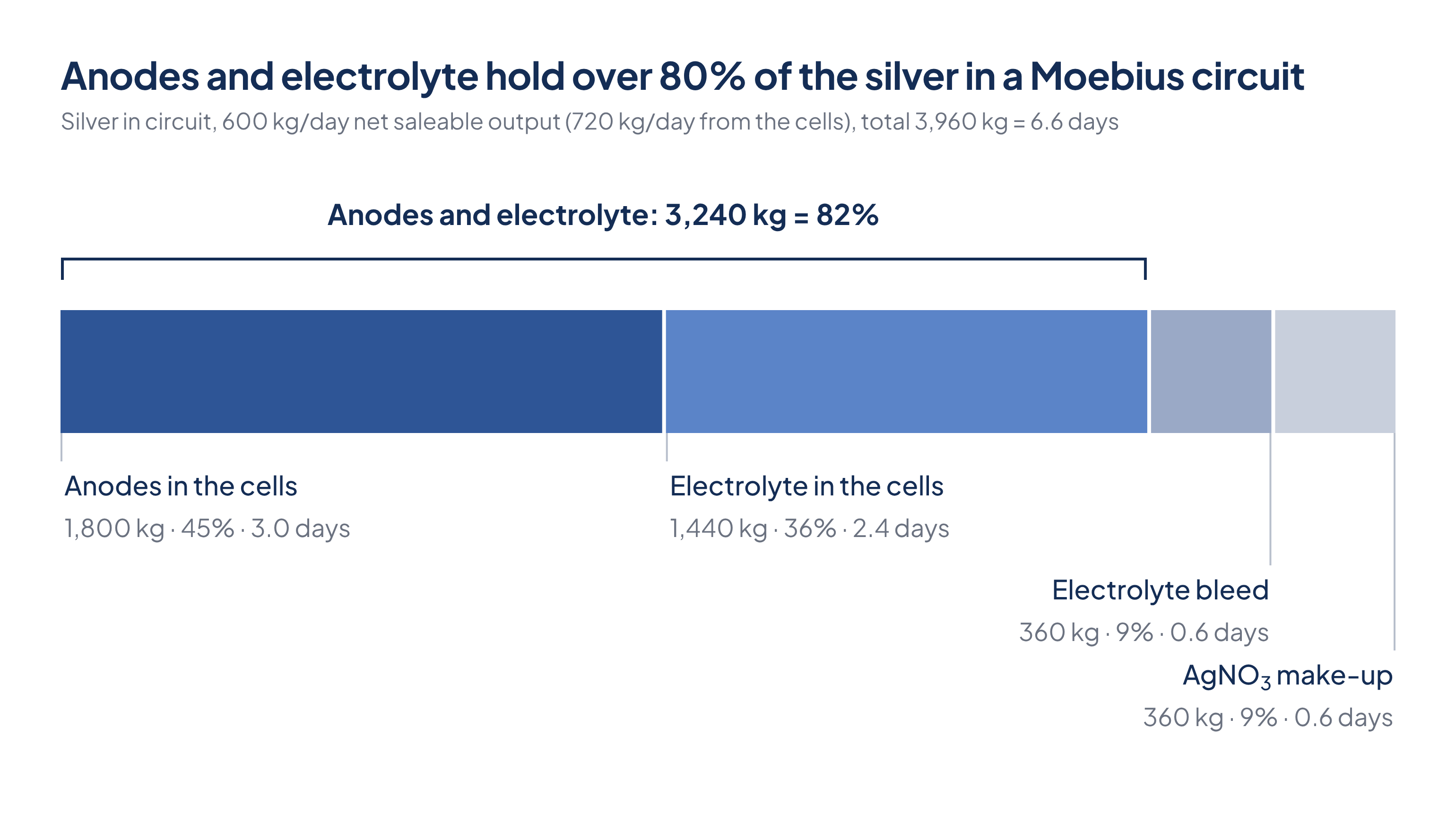
Next, the anodes, starting from a figure operators already know: anode weight. Each cell holds ten anodes of 15 kg each, so a fresh load across 24 cells weighs 3,600 kg. To make 720 kg/day (120 kg/day for preparation of make-up volume and 600 kg/day for sale) of silver from 90% Ag anodes, the cells dissolve 800 kg/day of anode (720 ÷ 0.9). Over a four-day cycle, that is 3,200 kg, so 400 kg (about 11% of the fresh load) is left as butts when the anodes are changed, to be remelted and recast. Anode weight in the cells therefore falls steadily from 3,600 kg to 400 kg, averaging 2,000 kg. At 90% Ag, that holds 1,800 kg of silver: metal that has been cast and deployed as impure anodes in the cells but not yet refined.
[(3,600 kg + 400 kg) ÷ 2 = 2,000 kg of anode] × 90% Ag = 1,800 kg Ag
The bleed and the make-up come from copper control. About a sixth of what the cells make, 120 kg/day, returns to the circuit as silver nitrate make-up. On average, about 360 kg of silver sits in bleed electrolyte waiting for recovery and re-refining, and another 360 kg in silver nitrate make-up waiting to go back into the cells.
Inventory multiple = silver in circuit (kg) ÷ net saleable output (kg/day) = 3,960 ÷ 600 = 6.6 days
Put simply, a Moebius refinery typically carries almost a week of production that it cannot sell. The same calculation at 150 kg/day gives 360 kg in the electrolyte, 450 kg in the anodes and 90 kg each in the bleed and make-up: 990 kg, or 6.6 days again, because every bucket scales with output.
The 6.6 days is a floor. It leaves out the fresh anodes already cast and waiting to go into the cells, and any silver in melting, casting and assay. Because anodes are cast in batches and must be ready when a cell is due for a change, plants typically keep about a day's supply on the rack; an earlier emew evaluation at 600 kg/day put this at about 810 kg of silver. Counting those, the plant holds about 8 days of output.
Silver also leaves the main path. About 120 kg/day, roughly 44 t a year at this size and 20% of net output, is bled out with the electrolyte and has to pass through chloride precipitation and zinc cementation before it can return as crystal.
The anodes tie up gold as well as silver. Gold and most of the palladium and platinum do not dissolve in the Moebius cell. They collect as slime in the anode bags and can only be recovered once the anodes are spent, about 5 days after the feed arrives with the anode changeover. A few ppm of palladium and platinum dissolve into the electrolyte instead and build up over time. In the emew circuit, nitric acid leaves gold and most of the palladium and platinum undissolved, so they are filtered out within 24 hours. A scavenger resin picks up the trace palladium and platinum dissolved in the leachate before the silver is recovered to ensure high purity of silver powder and maximum recovery of palladium and platinum.
The gold also comes out in a different form. On the 90% Ag / 10% Cu basis used here, emew recovers gold as undissolved metallic particles, typically 95% to 99% pure and ready for final refining to 99.99% by aqua regia or gold electrolysis. In a Moebius cell, gold stays in the anode slime at 60% to 85% Au, diluted by undissolved anode silver and silver oxides, so the slime needs further treatment first.
To reach 99.99% gold from Moebius slime, it takes three separate refining processes and 4 to 5 days. The emew residue needs one final refining step of about 1 day.
Why does lower-grade feed make Moebius inventory worse?
Copper. Every metal in the anode that is more reactive than silver dissolves with it, and nothing in a Moebius cell removes it. At 90% Ag, to make 720 kg/day of silver (600 kg/day sold), the cells dissolve 800 kg of anode a day and add 80 kg of copper to 14,400 L of electrolyte. Copper rises 5.6 g/L a day until it reaches about 60 g/L, so the electrolyte lasts about 10.8 days. Because electrolyte volume scales with output, the same is true at any plant size.
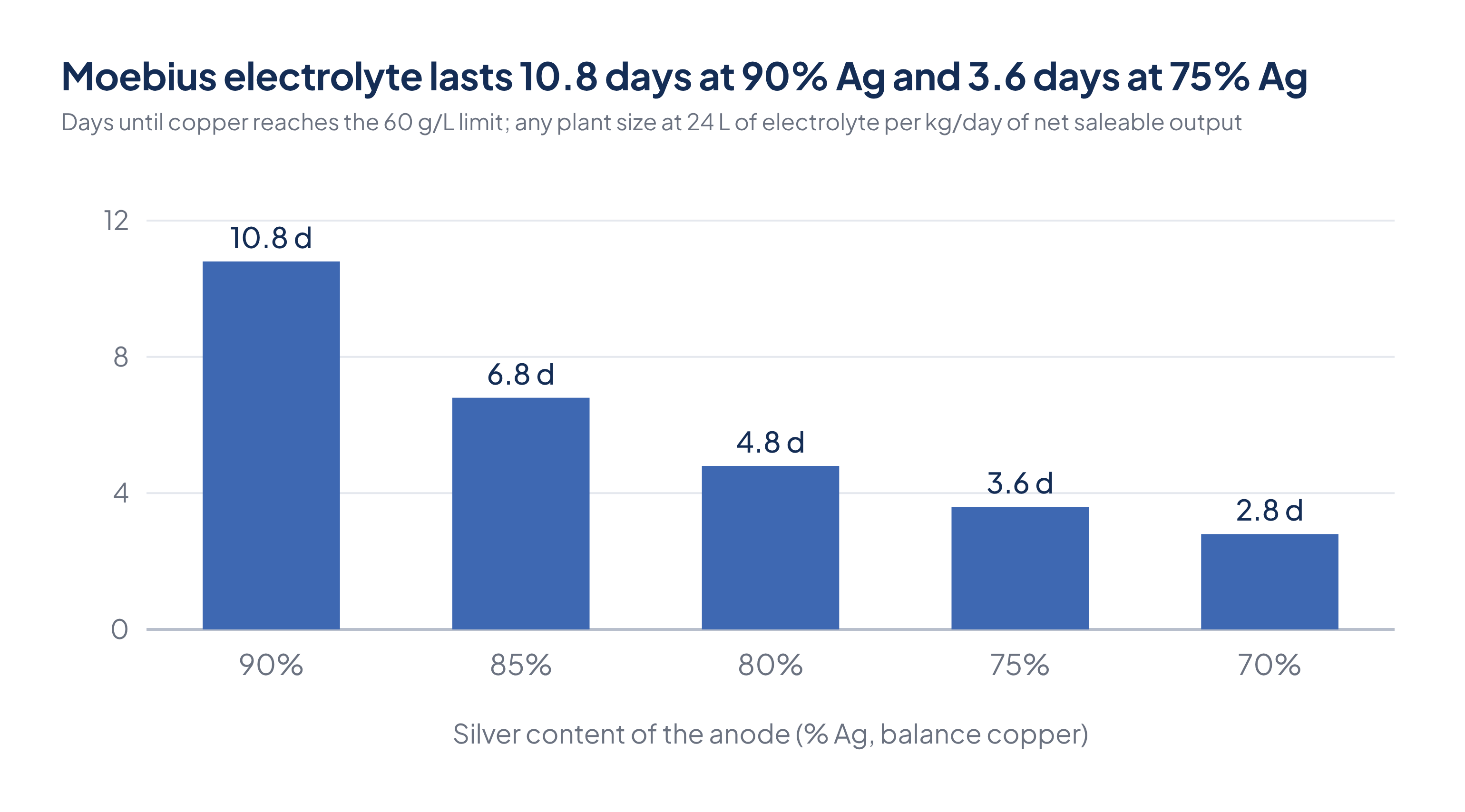
Each time the cell electrolyte is spent (full replacement), its 1,440 kg of dissolved silver goes through chloride precipitation and zinc cementation before it returns to anodes. At 25% copper, this happens three times as often as at 10% copper. Running the electrolyte at 200 to 300 g/L Ag stretches the interval, but the circuit then holds more silver overall. No Moebius set-up ties up less silver on lower-grade feed.
In a Moebius plant, each extra kilogram a day of copper shortens electrolyte life, sends more silver through the bleed/make-up loop and uses more nitric acid and caustic soda for copper hydroxide precipitation. In the emew circuit, it adds no silver inventory, though digestion still uses nitric acid to dissolve it.
How does emew electrowinning cut the inventory?
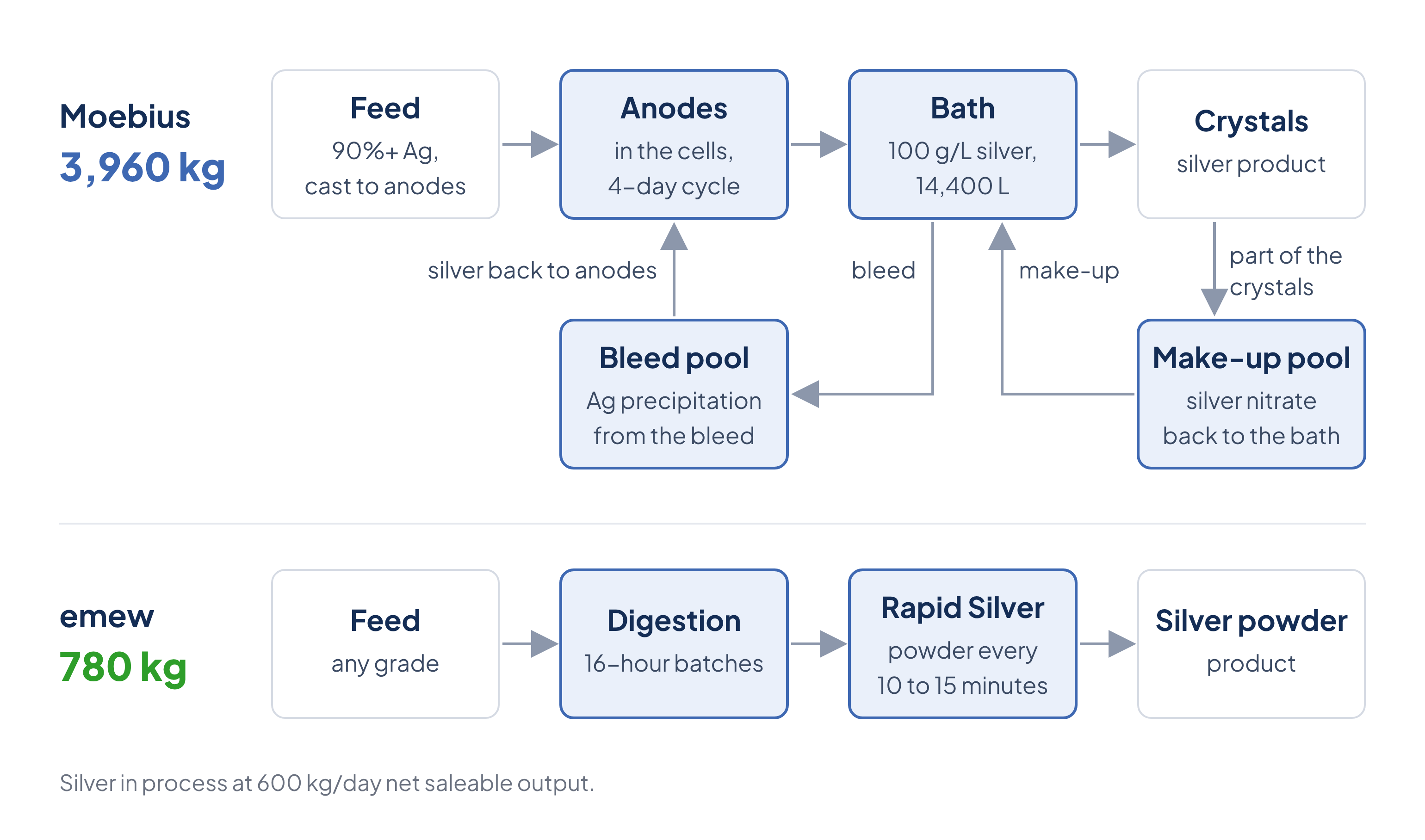
The emew route casts no anodes. It digests the feed in nitric acid, then recovers silver from solution in emew Powder cells: vortex, closed, high mass transfer electrowinning cells in which electrolyte swirls past a cylindrical cathode.
Electrowinning silver from nitrate solution is not new, but plate-style electrowinning circuits had a problem of their own. Because they neutralized the acid, sodium nitrate (NaNO3) built up in the circuit, and they produced a large volume of wastewater. The copper was still a problem and precipitated as hydroxide sludge. The emew circuit returns the regenerated acid to digestion instead of neutralizing it and recovers copper as cathode, so wastewater is minimal.
Four design features keep the inventory low.
- Digestion replaces the anode bank. Granulated feed dissolves in nitric acid in 16-hour batches in two staggered reactors, so a new batch starts every 12 hours. There is no four-day cycle holding silver in the cells. Gold and most of the PGMs leave as filter residue at the end of digestion, not 5 days later from anode bags.
- Silver deposits selectively. Silver reduces at the cathode at +0.799 V and copper at +0.337 V (standard potentials vs SHE; Bard et al., 1985). So, emew Powder cells recover silver powder of 99.95% to 99.99% purity, even in the presence of high copper. The gap is 0.46 V at standard conditions and still about 0.2 V at low silver levels.
- Silver leaves as product within the hour. Powder is flushed out of the emew Powder cells every 10 to 15 minutes, so only a thin working inventory ever sits in the vessels.
- A polish step strips silver from the bleed. When copper reaches the emew threshold, a bleed is taken out for copper recovery. But first it goes through emew Polish cells fitted with high-surface-area cathodes to extract the remaining silver from single-digit g/L down to single-digit mg/L. This de-silverized solution then enters the emew Plate cells for copper electrowinning.
The math at 600 kg/day for emew
Unlike the Moebius anode bank, none of the silver in the emew circuit sits idle for days; it keeps moving. Two digestion reactors are staggered so that a new 350 kg batch starts every 12 hours, each yielding 300 kg of product silver. Each batch digests for 16 hours, so for 4 hours in every 12 both reactors hold a batch, and digestion holds 350 kg × 16 h ÷ 12 h = 467 kg on average. The digested batch is then electrowon over 12 hours, from 350 kg down to about 50 kg, averaging (350 + 50) ÷ 2 = 200 kg, the same averaging used for the Moebius anodes. The remaining 120 kg is in the Polish, wash water and strip circuits.
467 kg (digestion, average) + 200 kg (electrowinning, average) + 120 kg (Polish, wash and strip) = 787 kg Ag
That is 1.31 kg of silver per kg/day sold (787 ÷ 600), about a fifth of the Moebius figure of 6.6, with no anode float and no silver parked for a multi-day cycle.
Rounded to 1.3 kg of silver per kg/day of net saleable output (780 kg at 600 kg/day), this is the base case used throughout this article. The same 16-hour digestion time and 12-hour batch interval apply at every capacity, so the factor holds from 150 to 600 kg/day. If space allows only one digestion reactor, the inventory rises to about 2 kg of silver per kg/day of net saleable output (1,200 kg at 600 kg/day), still less than a third of the Moebius figure.
Other benefits that do not change the inventory figures
- The acid made at the anode during electrowinning goes back to digest the next batch, regenerating 60% to 80% of theoretical nitric acid, so less fresh acid is bought.
- After the silver is out, emew Plate cells recover the copper from the same solution. At commercial scale, emew recovers around 90% of the copper as saleable cathode at about 90% current efficiency, whereas a Moebius circuit ends with copper hydroxide cake to dispose of.
- Gold and platinum group metals are released within 24 hours of digestion instead of waiting in the anode slime until the anodes are spent.
Operating cost, capital cost, labour and footprint depend on the plant and are not compared here.
How do silver inventory and its cost vary with plant size, silver price and lease rate?
Because every bucket scales with output, the inventory multiple is the same at any size: 6.6 days for Moebius and 1.3 days for emew.
Two things follow.
The percentage does not change with size: emew holds 80% less silver at every scale.
The cash does. A 150 kg/day refinery releases about 795 kg, a 600 kg/day refinery about 3,180 kg. Small plants feel it as a ratio; large plants feel it on the balance sheet.
Real plants vary around the model. emew's customer-specific engineering studies have put Moebius inventory between about 5 and 10 days of output, depending on electrolyte volume, silver concentration, anode cycle length and how much cast anode stock is counted.
Silver in the circuit has a cost whether it is leased, financed or owned. A lease rate is a direct charge; for owned silver, the same rate is the return the money could earn elsewhere. Either way:
Silver released = Moebius silver in circuit − emew silver in circuit
Annual lease cost avoided = silver released × silver price × lease or financing rate
The 8% rate used in the size table is roughly the one-month silver lease rate in January 2026 (TradingKey), and it is also close to many companies' cost of capital. The 2% rate is the top of the typical lease range before the squeeze. Your own rate depends on whether the silver is owned, leased or toll-refined for a customer. A toll refiner does not carry the metal on its balance sheet but still pays for insurance and for slower settlement to its customers. The table below shows how the kilograms and the inventory cost scale with capacity.
Price volatility matters as much as the rate. Silver traded below US$32/oz for most of 2024, peaked at about US$121.6/oz in January 2026 and was back near US$60/oz by the end of September. Every day a kilogram spends in process is a day of price exposure or hedging cost that a plant with less silver in circuit does not carry.
The table below shows the annual savings at 600 kg/day across a range of silver prices and rates.
Five questions to audit your refinery's silver WIP
You can do this sum with figures your plant already records.
- What is your total cell volume, and what silver concentration does the electrolyte run at?
- How much anode mass hangs in the cells when they are freshly loaded, and how much is left when they are changed?
- How much silver is in bled electrolyte and in silver nitrate make-up at any one time?
- How many kilograms a day do you sell, with make-up silver already taken out?
- How often do you change electrolyte, and how does that interval move with copper in the feed?
Add up the silver from the first three answers, taking the average of fresh and spent anode mass times the anode grade, and divide by the fourth. That is your inventory multiple, in days of net saleable output. If it is well above a few days, there is working capital to release. The fifth answer shows which way it is heading as feed grade falls.
emew vs Moebius: silver WIP at a glance
Frequently asked questions
How much silver does a Moebius refinery hold in process?
About 6.6 days of net saleable output on emew's model, before any stock of fresh anodes waiting to be loaded. At 600 kg/day, that is 3,960 kg: 1,800 kg in anodes, 1,440 kg in electrolyte and 360 kg each in bled electrolyte and AgNO3 make-up. At 150 kg/day, it is 990 kg.
Where is most of the silver in a Moebius circuit?
In the anodes and the electrolyte. In the 600 kg/day reference plant, they hold 1,800 kg and 1,440 kg, which together are 82% of the 3,960 kg total.
What is net saleable silver output?
The silver sold each day, after the make-up silver that returns to the circuit has been taken out. A plant whose cells make 720 kg/day, with 120 kg/day returning as make-up, has a net saleable output of 600 kg/day.
Why can't a Moebius plant just run with less silver?
Because the process sets the inventory, not operating habits. Cell volume has to carry the current, the electrolyte needs about 100 g/L Ag for clean crystals, and the anodes need enough mass to last four days. Raising electrolyte silver to 200 to 300 g/L makes the electrolyte last longer, but it adds silver in the cell volume.
Does inventory fall as plants get smaller?
The kilograms do; the multiple does not. Every bucket scales with output, so a 150 kg/day refinery also holds about 6.6 days of production in process.
Does electrowinning give lower purity than electrorefining?
No. Moebius refineries can also make 99.99% crystal, though our model assumes 99.95%. The same emew equipment can run in 9999 mode or a higher-throughput 9995 mode.
How long does silver take to get from feed to product?
Under 24 hours in the emew circuit: the first silver powder starts coming out and then runs continuously. In emew, a batch takes about 1 day from receipt to silver powder, and gold is in the residue within 24 hours. In a Moebius plant, a batch takes about 5 days from receipt to silver crystal, and gold in the anode slime takes about 5 days.
What happens to the copper?
In a Moebius plant, copper ends up in a hydroxide cake that goes to disposal. In the emew circuit, emew Plate cells recover 90% of it as saleable copper cathode, and the anode reaction regenerates nitric acid for the next digestion.
Does the emew route handle feed below 90% Ag?
Yes. The more copper the feed carries, the more the emew route saves. In emew commercial campaigns and lab tests on 77% Ag granules with 15% Cu, 4% Zn and 4% Cd, the circuit still produced 99.99% silver.
Is emew electrowinning proven at commercial scale?
emew has been in commercial service since 1992 and has sold silver systems since 2008. Installed emew silver capacity now exceeds 9,000 kg/day worldwide.
Can emew replace an existing Moebius circuit?
Yes. The system is modular and fits brownfield upgrades as well as new plants. emew sizes the circuit from your feed assay, target output and existing layout.
How we got these numbers
The Moebius figures come from an emew model, not a plant survey. The reference plant sells 600 kg/day of fine silver from 90% Ag / 10% Cu anodes, with 24 cells of 600 L, ten 15 kg anodes per cell, a 100 g/L Ag electrolyte, a 60 g/L copper limit and a four-day anode cycle that dissolves about 89% of each anode. The cells make 720 kg/day because about a sixth of cell output returns as AgNO3 make-up, and every multiple is measured against the 600 kg/day sold. The circuit total counts the electrolyte, the anodes in the cells, the bleed electrolyte and the matching make-up pool. It leaves out fresh anode stock and silver in melting, casting and assay, so it is a floor. 90% silver is the most favourable grade for Moebius, so lower-grade feed makes the comparison better for emew, not worse.
The emew figure of 1.3 days is a base case, not a design. It assumes two digestion reactors staggered by 12 hours, with 16 hours of digestion per batch and 12 hours of electrowinning per batch. It averages the silver in digestion over the overlap between the two reactors (0.78 days), averages each electrowinning batch from full to heel in the same way as the Moebius anodes (0.33 days), includes 0.2 days for the Polish, wash and strip circuits, and rounds the resulting 1.31 days to 1.3. With only one digestion reactor, the figure rises to about 2 days. A specific design uses your feed assay, target output and layout. The emew performance figures (purity, polishing, copper recovery and acid regeneration) are based on emew testing and operational data: commercial silver campaigns, two lab digestion and electrowinning campaigns, copper and polishing runs, and commercial emew Plate cell data.
Prices use the Kitco spot price at the end of September 2026, rounded to US$60/oz (US$59.98/oz on 30 September), or US$1,929/kg. Annual figures use 364 operating days. Price and rate are illustrative; use your own. This article covers silver in process only.
Run the numbers on your plant
Send your net saleable output, feed analysis and lease rate to the emew process team at info@emew.com, and we will run the comparison on your actual figures.
More at www.emew.com.
Sources
- emew Clean Technologies, testing and operational data: silver digestion, electrowinning and polishing campaigns, and copper recovery from nitrate bleed, 2026.
- emew Moebius refinery model: 150, 300 and 600 kg/day silver electrorefining inventory and reagent data, October 2026.
- F. Habashi, Handbook of Extractive Metallurgy, Vol. III, Wiley-VCH, 1997.
- A. J. Bard, R. Parsons, J. Jordan, Standard Potentials in Aqueous Solution, Marcel Dekker, 1985.
- Kitco silver price chart, accessed 30 September 2026.
- Phoenix Refining, "Silver Liquidity Paradox of 2026".
- TradingKey, "2026 Silver Run", 19 January 2026.
- Bloomberg, "Silver Lease Rates Plunge as Historic Market Squeeze Eases", 27 October 2025.

Related posts
Copper’s New Journey: From Global Shipments to Local Refining and What It Means for E-Waste


Silver refining

Bosch Australia: Premier's Sustainability Award for Recovering Copper from Wastewater!